
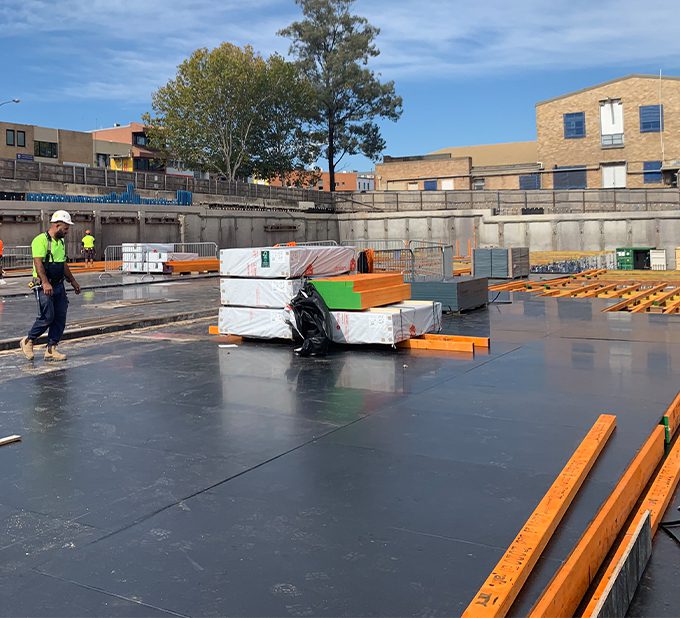
When the formwork comes off, the concrete doesn’t lie. Every ripple, every joint shadow, every surface inconsistency is right there for the world to see and in exposed or architectural applications, that finish is the product. For formwork contractors and architects specifying off-form concrete, the quality of the formply sheeting is one of the most consequential decisions made before a single pour.
Auswood’s Enviroform Formply is engineered specifically with this outcome in mind. Here’s what sets it apart and why the details inside the panel matter as much as the surface you see.
What Is a Class 2 Concrete Finish and Why Does It Matter?
Australian Standard AS 3610 defines surface finish classifications for formed concrete. A Class 2 finish is the benchmark for exposed architectural concrete, surfaces that will remain visible in the completed structure, whether that’s a facade wall, a feature ceiling, an underside soffit, or a public colonnade. The requirements are stringent: minimal blemishes, consistent colour and texture, no significant blowholes, and tight dimensional tolerance.
Achieving Class 2 consistently across multiple pours and reuses of the same panel is where most formply products fall short. Standard overlaid plywood can deliver a Class 2 result on the first pour, but surface degradation, minor waviness, and inconsistent release on subsequent uses often introduce variation that pushes results toward Class 3 territory. For architects specifying exposed concrete, that variability is not acceptable.
The Reconstituted Veneer Advantage
What makes formply different from standard Dynea-overlaid formply begins beneath the surface film.
Standard formply products apply a phenolic Dynea overlay directly onto the outer hardwood veneer. The challenge is that hardwood veneer, even at tight manufacturing tolerances, has natural grain relief and minor surface variation. When the overlay is bonded directly to this veneer, the film can conform slightly to those micro-variations leading to subtle surface texture, minor wave, and reduced hardness uniformity across the panel face.
Enviroform addresses this with a reconstituted veneer cushion layer positioned between the outer Dynea overlay and the structural plywood core. Reconstituted veneer is a manufactured product with an extremely consistent, grain-free surface profile. It acts as a levelling substrate providing a uniform base for the Dynea film to bond against.
The practical results are significant:
Improved surface hardness and flatness. With the cushion layer eliminating micro-relief variation from the substrate, the Dynea overlay sits on a flatter, more consistent surface. This translates directly into improved hardness and dimensional consistency across the panel face – the prerequisites for reliable Class 2 results.
More consistent Class 2 outcomes. Because the surface quality is more uniform across the panel and across the production batch, the variability that can push results toward Class 3 is substantially reduced. Contractors can specify Class 2 with greater confidence that the result will be achieved not just on the first pour, but across subsequent uses.
Extended reuse life. A harder, flatter, more consistent overlay surface handles the repeated mechanical stresses of concrete pouring, stripping, and cleaning with less degradation. Panels maintain their Class 2 capability through more reuse cycles which directly affects the economics of the job.
The Dynea Overlay: 60/165 gsm
Enviroform uses a 60/165 gsm Dynea overlay, that provides the non-stick, moisture-resistant, abrasion-resistant surface interface with the concrete.
This is the same overlay specification used in high-quality formply globally, and it’s worth understanding why the combination with the reconstituted veneer cushion matters. The Dynea overlay itself is a well-proven technology. What the reconstituted veneer beneath it does is ensure the overlay performs to its full potential because the overlay is only as flat and consistent as the substrate it’s bonded to.
Structural Performance: F17 Grade
Enviroform is rated to F17 stress grade under AS/NZS 2269, the structural plywood standard applicable to formwork applications.
F17 provides the stiffness and load-bearing performance necessary to minimise mid-panel deflection under concrete load. Deflection, even minor bowing between support points, is one of the main causes of surface waviness in off-form concrete, and it compounds across the height of a wall or the span of a slab soffit. Maintaining panel flatness under load is not just a structural requirement; it’s a surface finish requirement.
Auswood publishes a full span table for Enviroform Formply. Specifiers and contractors should reference this span table when determining prop spacing and bearer layouts. Using Auswood’s span data ensures that the formwork design keeps deflection within the limits required for the specified surface class a step that is often overlooked and is one of the most common sources of finish problems that can’t be attributed to the panel itself.
Moisture Resistance: A-Bond and Edge Sealing
Enviroform formply is manufactured with A-Bond (phenol formaldehyde) adhesive and factory-applied water-resistant edge sealant in grey. These are baseline requirements for any formwork plywood used in wet concrete applications, and they’re standard features of the product.
Edge sealing is worth a brief mention in the context of finish quality: delamination that starts at the panel edge from repeated moisture cycling can migrate inward over time and create surface inconsistencies that affect the concrete face. Factory-sealed edges extend panel life and help maintain surface integrity over the reuse cycle. On site, any cut edges should be sealed with a compatible sealant to maintain this protection.
Specifier Tips for Critical Finish Quality
For architects and project teams specifying exposed concrete finishes, a few practical considerations:
Reference the surface class in the formwork specification, not just the concrete specification. AS 3610 governs both the formed surface class and the concrete’s own surface quality. Specifying Class 2 under AS 3610 creates a clear, contractual quality benchmark for the formwork contractor.
Specify the formply product, not just the overlay type. Not all Dynea-overlaid plywood performs the same way. The substrate construction, including whether a reconstituted veneer cushion layer is present, materially affects surface consistency and reuse performance. Product-level specification protects the design intent.
Use Auswood’s span table for prop and bearer spacing. Deflection control is as important as panel surface quality. The span table is the tool that connects structural design with surface finish outcome.
Discuss reuse cycles with the formwork contractor. Enviroform formply’s extended reuse capability is an advantage, but panels should be inspected between uses. A panel that has experienced edge damage or surface wear beyond its Class 2 capability should be rotated to Class 3 applications rather than used where exposed finish is required.
Consider release agent compatibility. The Dynea overlay is designed for use with appropriate concrete release agents. Using the right release agent applied correctly and consistently is part of achieving reliable Class 2 results. The panel provides the capability; the release agent is part of the system.
The Bottom Line
In exposed and architectural concrete applications, the surface finish is permanent. It cannot be corrected after stripping without remediation that is itself visible. The quality of the formply and specifically the consistency and flatness of the panel face, is one of the most controllable variables in achieving the specified result.
Enviroform Formply’s reconstituted veneer cushion layer is not a marketing feature. It’s an engineering decision that addresses a real mechanism of surface variation – and the result is more consistent Class 2 outcomes, better release quality, and longer productive panel life.
For project-specific guidance, span table access, or product samples, contact the Auswood team across Sydney, Melbourne, and Brisbane.
Auswood manufactures and supplies Enviroform Formply and a complete range of formwork materials including Envirobeam LVL, H20 Beams, and accessories. Visit auswood.com.au or call 1800 888 986.